
Architecture Overview
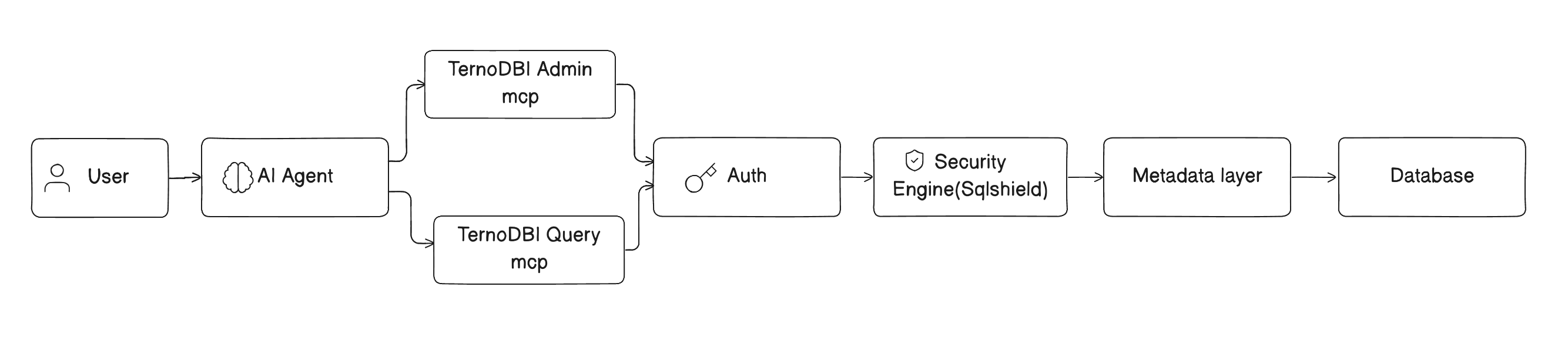
TernoDBI is designed as a Database Interface Layer that sits between your AI Agents and your physical data warehouses. It solves the "last mile" problem of letting LLMs query databases securely.
System Diagram
Core Components
1. The MCP Layer
TernoDBI exposes two distinct servers via the Model Context Protocol:
- Query Server: Read-only. Exposes tools like
list_tables,list_table_columns, andexecute_query. Designed for safety. - Admin Server: Write-access. Exposes tools like
rename_table,update_table_description, andvalidate_connection. Designed for human-in-the-loop curation.
2. SQLShield
The security engine. It parses every incoming SQL query into an Abstract Syntax Tree (AST) using
sqlglot.
- Validation: Rejects mutations (
INSERT,DROP,ALTER). - Transformation: Can rewrite queries (e.g., forcing
LIMIT, applying Row Level Security). - Dialect Translation: Converts generic SQL into database-specific dialects (e.g., handling BigQuery backticks vs Postgres quotes).
3. Unified Connector System
A factory-based abstraction over SQLAlchemy and native drivers.
- Single Interface: Application code (and Agents) interact with a single
Connectorinterface. - Complexity Handling: TernoDBI handles the complexity of connection pooling, cursor management, and type conversion for each backend.
4. Service Token Authentication
A custom authentication system designed for agents.
- Scopes: Tokens can be global or restricted to specific Datasource IDs.
- Expiration: Tokens can be short-lived (e.g., ephemeral tokens for a specific chat session).
- Audit: Usage is tracked per-token.